
MabDesign’s market analyses give you a monthly overview of market dynamics and projects in development for a given indication or technology, to help you better understand the constantly evolving market of biologics and biomanufacturing. This month, an overview of the market and projects currently under development for the treatment of multiple sclerosis (MS).
Market & pipeline analysis
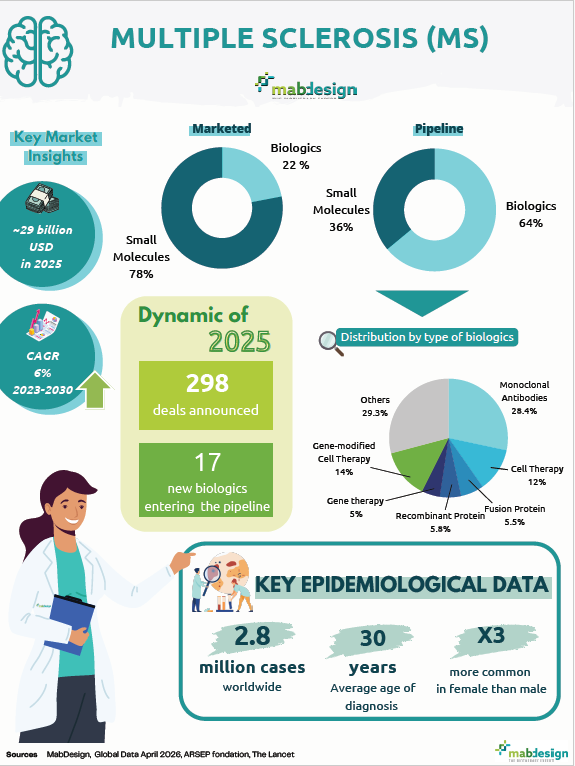
Multiple sclerosis (MS) is a chronic autoimmune disease of the central nervous system, affecting approximately 2.8 million people worldwide. The average age of diagnosis is around 30 years old, making it a condition with significant socio-economic impact due to its onset during early adulthood. Furthermore, MS is three times more common in women than in men, underlining the need to consider sex-specific factors in both clinical care and therapeutic development strategies.
2,8
million cases worldwide
30 years
age of diagnosis (average)
3x
more common in female than males
Multiple sclerosis market and pipeline
The global MS therapeutic market is expected to reach 29 billion USD in 2025, with a compound annual growth rate (CAGR) of 6% between 2023 and 2030, reflecting a dynamic and innovation-driven landscape.
Currently, the market is largely dominated by small molecules, which account for 78% of marketed products, while biologics represent only 22%.
Marketed
Pipeline
However, a clear shift toward biologics is emerging: within the development pipeline, biologics now represent 64% of ongoing projects, versus 36% for small molecules, highlighting a move toward more targeted and complex therapeutic approaches.In 2025, the innovation momentum is strong, with 298 new deals announced and 17 new biologics entering the pipeline.
Distribution by type of biologics
The biologics segment shows an increasing diversity of modalities:
- 28.4% are monoclonal antibodies,
- 12% are cell therapies,
- 5.5% fusion proteins,
- 5.8% recombinant proteins,
- 4.8% gene therapies,
- and 13.5% gene-modified cell therapies.
This diversity reflects an ambition to address persistent unmet needs, particularly regarding immune modulation, strategies to cross the blood-brain barrier, and adapting treatments to the heterogeneous clinical profiles of MS patients.
Download our infographic
projets de thérapies basées sur l’édition du génome (gene-editing therapies) actuellement en développement. (2025)
Want to know more?
MabDesign has acquired and cultivated expertise in all market segments associated with biopharmaceuticals and biomanufacturing. Our team of consultants is available to assist you with all your biotherapy-related projects. Feel free to explore our range of services, including our marketing and strategic analyses, if you would like to learn more!
Sources : MabDesign & GlobalData
Date – Août 2025