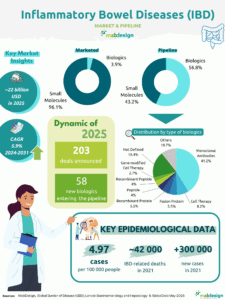

To mark Breast Cancer Awareness Month, MabDesign provides a new overview of market dynamics and development programs in breast cancer, focusing on the growing role of biotherapies and the transformations currently reshaping the clinical pipeline.
Breast cancer remains a major global health challenge.
In 2024, an estimated 2.43 million new cases were recorded worldwide, resulting in nearly 694,000 deaths. It therefore remains the most frequently diagnosed cancer among women.
In addition, approximately 8.16 million women were alive in 2024 after having been diagnosed with breast cancer within the previous five years, highlighting the size of the population requiring follow-up and care.
Epidemiological data
2.43 M new cases worldwide in 2024
694,000 deaths worldwide in 2024
8.16 M people alive who had been diagnosed within the previous five years
Market and pipeline of biotherapies in breast cancer
MabDesign’s analysis based on GlobalData (extract dated 28 September 2026) identifies 120 unique marketed products and 536 unique products in the active clinical pipeline, from Phase 0 through Phase III.
The marketed landscape is strongly shaped by biosimilars: they account for 74 of the 120 unique products identified, reflecting the maturity of several established biotherapies, particularly antibodies, and intensifying competition around these reference products.
Because the same product is frequently developed across multiple breast cancer populations, the detailed analysis is primarily based on product × indication pairs: 166 marketed pairs and 749 pairs in active clinical development.
Distribution of the active pipeline by clinical phase
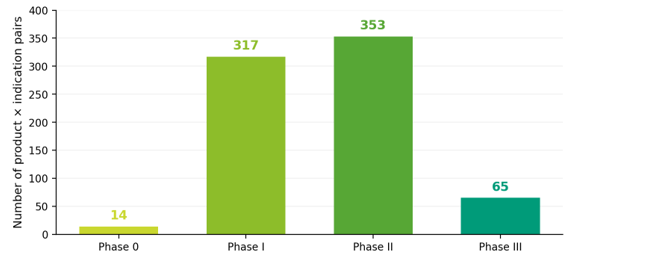
This pipeline is dense: 353 product × indication pairs are in Phase II, 317 in Phase I and 65 in Phase III, in addition to 14 programs in Phase 0. Phase II is therefore the most represented development stage.
Distribution of marketed and development-stage biotherapies by therapeutic modality
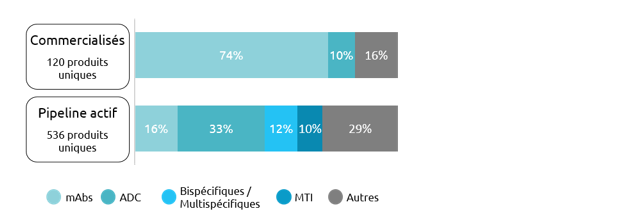
What stands out most, however, is the shift in therapeutic modalities. While the marketed landscape remains overwhelmingly dominated by monoclonal antibodies, which account for 73.5% of marketed pairs, their share falls to 16.4% of the clinical pipeline. Conversely, antibody-drug conjugates (ADCs) account for only 10.2% of the marketed cohort but have become the leading modality in the pipeline, representing 33.1% of clinical programs. Bispecific and multispecific antibodies account for another 12.4%, while genetically modified cells reach 9.6%.
Overall, this points to a progressive renewal of the biotherapy landscape, with approaches combining tumor targeting, delivery of cytotoxic payloads, and modulation of the immune response.
Overall, this points to a progressive renewal of the biotherapy landscape, with approaches combining tumor targeting, delivery of cytotoxic payloads, and modulation of the immune response.
An increasingly diversified pipeline across tumor subtypes and targets
Distribution of the active clinical pipeline by breast cancer subtype
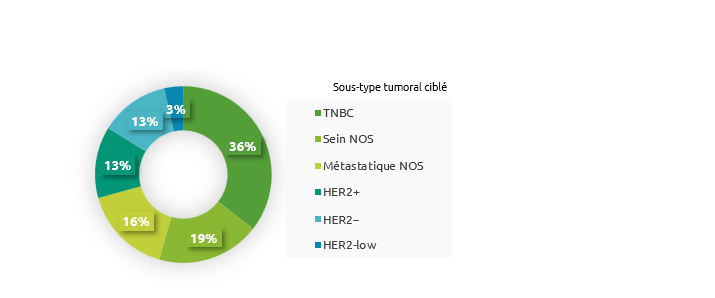
Triple-negative breast cancer (TNBC) currently concentrates the greatest development activity: 266 product × indication pairs, representing 36% of the clinical pipeline. HER2-positive and HER2-negative breast cancers each account for 13% of programs, while HER2-low is explicitly represented in 3% of pairs. A substantial share of the pipeline, however, is still registered under indications without a specific biomarker characterization, limiting comprehensive biological segmentation.
Distribution of the active clinical pipeline by main therapeutic targets
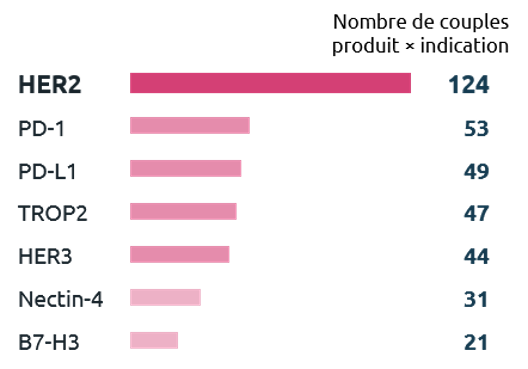
Diversification appears also at the target level. HER2/ERBB2 remains by far the most represented target, appearing in 124 pipeline pairs. However, other antigens are gaining prominence, including TROP2, HER3, Nectin-4 and B7-H3, alongside the PD-1 and PD-L1 immune checkpoints.
Competition is therefore no longer centered on HER2 alone: it is expanding toward new surface antigens and different therapeutic architectures, particularly ADCs and bispecific antibodies.
A competitive landscape evolving alongside advances in ADCs
The breast cancer biotherapy landscape is evolving through both the emergence of new players in the pipeline and the rapid progression of new modalities toward the market. While Roche, AstraZeneca, Merck and Gilead are among the main players in the marketed cohort, the pipeline is bringing forward or strengthening the presence of companies such as Hengrui, SystImmune/Biokin, BioNTech, Daiichi Sankyo, Akeso and CSPC, notably reflecting the rise of ADCs and new generations of antibodies.
This dynamic is already translating into regulatory progress. Recent approvals show ADCs moving into earlier lines of treatment and becoming integrated into combination strategies:
- · In December 2025, Enhertu + pertuzumab was approved as first-line treatment for metastatic HER2-positive breast cancer
- · In May 2026, Enhertu expanded into early HER2-positive breast cancer in the neoadjuvant and adjuvant settings
- · In June 2026, Trodelvy + pembrolizumab reached first-line treatment for PD-L1-positive TNBC
The renewal of the competitive landscape is therefore accompanied by a changing role for ADCs, which are progressively moving from later-line treatments to central components of earlier and combination therapeutic strategies.
Download our infographic
Explore at a glance the key market and pipeline figures for breast cancer biotherapies: development stages, therapeutic modalities, tumor subtypes, key targets, and examples of recent approvals.
Want to learn more?
MabDesign supports biotherapy stakeholders with Business Intelligence challenges through market studies, pipeline and competitive analyses, technology benchmarks, and tailored strategic analyses. Scientific and business intelligence studies are part of MabDesign’s support offering.
Looking to better understand a market, pipeline, or competitive environment?
Let’s discuss your needs: marketstudy@mabdesign.fr
Sources: IARC – GLOBOCAN 2024, data published in July 2026; MabDesign analysis based on GlobalData, extract dated 28 September 2026; FDA, regulatory decisions accessed in September 2026.
Download our infographic
projets de thérapies basées sur l’édition du génome (gene-editing therapies) actuellement en développement. (2025)
Do you want to know more?
MabDesign a acquis et développé une expertise dans tous les segments de marché liés aux produits biopharmaceutiques et à la fabrication de produits biologiques. Notre équipe de consultants se tient à votre disposition pour vous accompagner dans tous vos projets de biothérapie. N’hésitez pas à découvrir notre gamme de services, notamment nos analyses marketing et stratégiques, si vous souhaitez en savoir plus !
Sources: MabDesign & GlobalData
Date – October 2026