
For Movember, MabDesign offers a new look at market dynamics and projects in development for prostate cancer, focusing on the diversification of therapeutic approaches, the main targets being explored, and recent developments in the clinical pipeline. Movember is an initiative dedicated to men’s health, supporting awareness and research on prostate cancer.
Prostate cancer remains a big health problem worldwide. According to the GLOBOCAN 2024 data published by IARC in July 2026, it’s estimated that there will be 1.55 million new cases globally in 2024, with nearly 420,000 deaths. Also, about 5.18 million people were still alive in 2024 after being diagnosed with prostate cancer in the previous five years.
Epidemiological data
- 1.55 million new cases worldwide in 2024
- 420,000 deaths worldwide in 2024
- 5.18 million people alive who were diagnosed in the past five years.
Market and pipeline of biotherapies in prostate cancer
The MabDesign analysis identifies 81 marketed product references and 262 unique references in the clinical pipeline, from phase 0 to phase III. These 262 products correspond to 302 product × indication pairs – the same product can be developed in multiple clinical contexts.
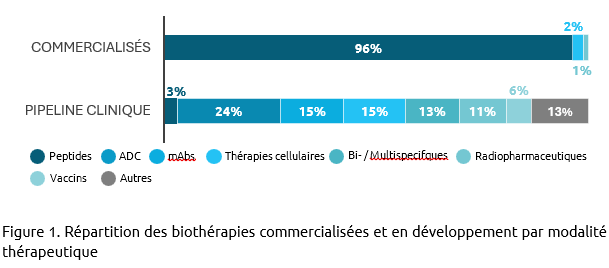
The comparison highlights two very different profiles. The marketed portfolio is largely dominated by peptides and their combinations, which account for 78 of the 81 listed references. It is also heavily influenced by generics: 61 out of 81 references, or 75.3%, are coded as generics.
A much more diverse clinical pipeline
The landscape is noticeably different when looking at products in clinical development. ADCs make up the leading category, with 64 out of 262 products, or 24.4% of the clinical pipeline. They’re followed by monoclonal antibodies (14.9%), cell therapies (14.5%), bi- or multispecific formats (12.6%), and radiopharmaceuticals (11.1%).
A pipeline mainly focused on phases I and II
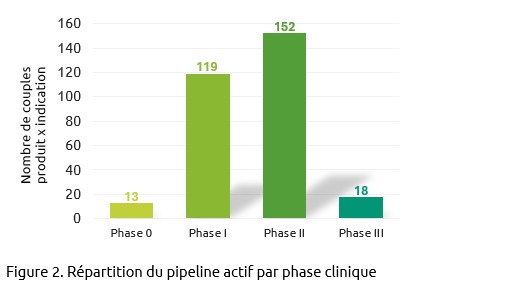
The analysis by product × indication pair shows a strong concentration of programs in the middle stages of clinical development. Out of 302 clinical pairs, 152 are in phase II and 119 in phase I, compared to 18 in phase III and 13 in phase 0. So phase II represents 50.3% of the developments listed, while only 6% have reached phase III.
This breakdown shows a pipeline that is well-supplied but still mostly in the early stages of development.
PSMA dominates the target landscape
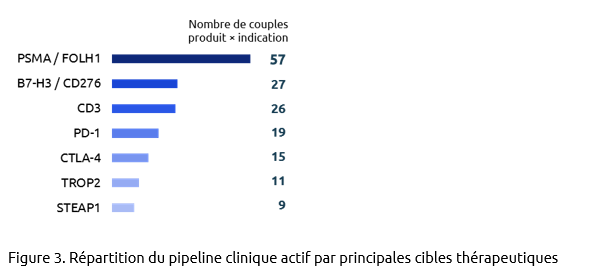
The diversification of methods comes with a variety of targeting strategies. PSMA/FOLH1 appears to be the most represented target in the extraction, with 57 product × indication pairs, ahead of B7-H3/CD276 (27), CD3 (26), PD-1 (19), and CTLA-4 (15).
PSMA is not limited to radioligands either: in the extract, this target is being explored across several platforms, including radiopharmaceuticals, genetically modified cell therapies, bi-/multi-specific formats, and ADCs.
A development still largely focused on the frontlines
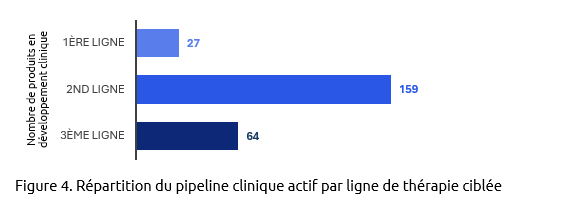
Among the 213 clinical products for which a line of treatment is specified, 159 appear in the second line, 64 in the third line, and 27 in the first line; 10 are also associated with an adjuvant context.
These categories aren’t mutually exclusive, the same product can be studied in several processing lines.
This shift towards advanced lines is consistent with the role of mCRPC — metastatic castration-resistant prostate cancer — which is the primary targeted indication, with 129 out of 302 product × indication pairs (42.7%).
Recent milestones that show the diversification of approaches
Several recent developments concretely illustrate this diversification of therapeutic approaches.
- In September 2025, pasritamig (JNJ-78278343) entered the phase III KLK2-comPAS study (NCT07164443) in mCRPC. This bispecific T-cell engager antibody targets KLK2 on tumor cells and CD3 on T lymphocytes. The study is currently listed as Enrolling by Johnson & Johnson.
- On July 31, 2026, the FDA granted an indication extension for Pluvicto (lutetium Lu 177 vipivotide tetraxetan) in combination with an androgen receptor pathway inhibitor (ARPI) for patients with PSMA+ metastatic prostate cancer who are androgen pathway modulation-naïve/sensitive, previously called mHSPC. This decision expands the use of this radioligand therapy to an earlier stage of metastatic disease. The ^177Lu-PSMA-617 program became part of Novartis’ portfolio following the acquisition of Endocyte, completed in December 2018.
- Finally, risvutatug rezetecan (GSK5764227 / HS-20093), an ADC targeting B7-H3, is now being evaluated in phase III in the EMBOLD Prostate-302 study (NCT07802704) in patients with mCRPC. GSK’s official registry indicates a study that started in September 2026 and is currently recruiting. GSK holds the development and commercialization rights outside mainland China, Hong Kong, Macao, and Taiwan under a licensing agreement with Hansoh Pharma signed in December 2023.
These examples illustrate an innovation landscape where ADCs, T-cell engagers, and radioligands are moving forward at the same time, each with different targeting strategies and clinical positions.
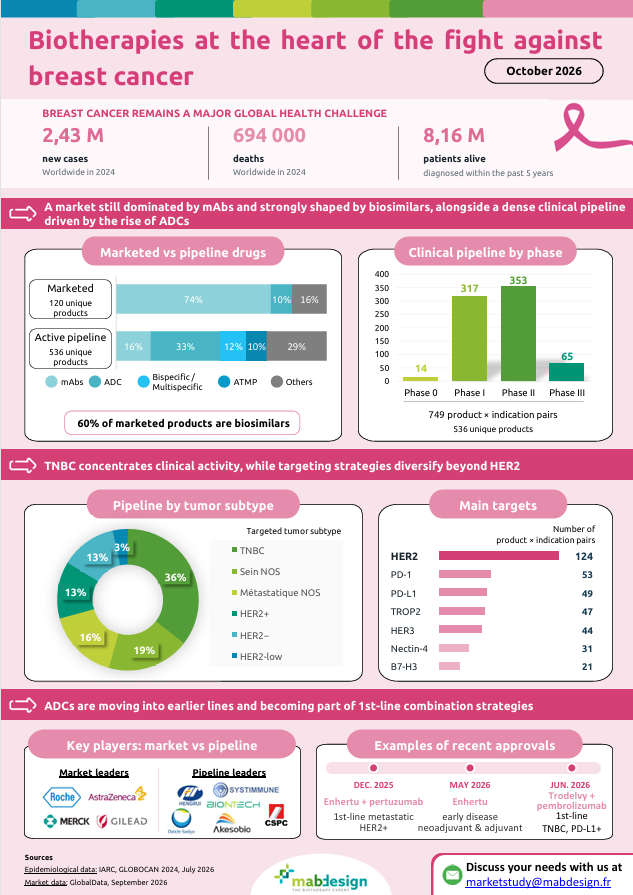
Download our infographic
Take a quick look at the main market and pipeline numbers in prostate cancer: development stages, treatment types, lines of therapy, key targets, and examples of recent clinical and regulatory milestones.
Do you want to know more?
MabDesign supports players in biotherapy with their Business Intelligence challenges through market studies, pipeline and competitor analyses, technology benchmarks, and customized strategic analyses.
Looking to better understand a market, pipeline, or competitive environment?
Sources :
Sources : IARC – GLOBOCAN 2024, données publiées en juillet 2026 ; Analyse MabDesign basée sur GlobalData, extraction du 19 octobre 2026 ; FDA ; registres et communications officielles Johnson & Johnson, Novartis et GSK, consultés en octobre 2026.
Date – November 2026